
In several areas, the Indian government has put out a model law.

Prices of food items like cereals, pulses, and edible oils rose or remained steady in May, a Reserve Bank of India (RBI) report said, indicating there could be another higher inflation print. However, it observed that the Monetary Policy Committee's (MPC's) surprise move to increase interest rates bodes well for its credibility. The RBI's monthly State of the Economy report, released on Tuesday, citing high frequency food price data from the Ministry of Consumer Affairs for the period May 1-12, said the increase in the prices of cereals was primarily because of the surge in wheat prices.

A day after facing massive erosion from their wealth, equity investors became richer by Rs 13.22 lakh crore on Wednesday with markets making a strong comeback. The 30-share BSE Sensex jumped 2,303.19 points, or 3.20 per cent, to settle at 74,382.24. During the day, it rallied 2,455.77 points, or 3.40 per cent, to 74,534.82.

"We will raise Rs 300 crore via bonds of two-, three- and five-year tenures. This will be our maiden bond issuance and is part of our effort to widen funding sources," says Vimal Bhandari, executive vice-chairman and chief executive officer (CEO), Arka Fincap. The firm, a subsidiary of Kirloskar Oil, is only five years old and small (assets of around Rs 5,000 crore with an "AA" rating), but the response to this float will be closely watched: It would be the first by a non-banking finance company (NBFC) after Mint Road upped the risk weights on bank exposures to them by 25 percentage points. The move by the Reserve Bank of India (RBI) has caught NBFCs off guard even though the issue had been flagged by Governor Shaktikanta Das with their corner-room occupants (and that of banks) in July and August 2023 - on consumer credit and the dependency on bank borrowings.

Finance Minister Nirmala Sitharaman on Monday said she is awaiting an approval from the Cabinet on bill on cryptocurrency as the proposed legislation is before it. The inter-ministerial panel on cryptocurrency under the chairmanship of secretary (economic affairs) to study the issues related to virtual currencies and propose specific actions has already submitted its report. It has recommended that all private cryptocurrencies, except any virtual currencies issued by state, will be prohibited in India.

The growing complexity of E2Ws and the evolving threat landscape make it challenging to guarantee complete immunity from attacks.

Senior bankers point out that while they will eventually attract qualified professionals, onboarding them takes time.

Payouts to key management personnel in non-banking financial companies (NBFCs) are under the banking regulator's scrutiny. Top industry officials said this is a follow-through on the Reserve Bank of India's (RBI's) circular of April 29, 2022, which asked NBFCs in the "middle" and "upper" layer of its four-tiered scale-based regulatory (SBR) framework to put in place a board-approved compensation policy.

The IMF's Financial System Stability Assessment Update said India had improved its supervision and regulations in the 20 years since it started liberalising its economy and that its financial system fared well in the global financial crisis.

Prices may go up because of higher energy costs, caused by the rise in shipping charges, with commercial vessels taking a longer route to avoid the troubled Red Sea region, the finance ministry said on Monday. Iran-backed Houthi rebels of Yemen are repeatedly attacking ships in the Red Sea. While the global economy is grappling with challenges such as sticky inflation, sluggish growth, and mounting fiscal pressure, India's external sector could face "potential risks" due to the ongoing geopolitical tensions, according to the finance ministry's report on the review of the Indian economy.

The Board of Control for cricket in India has cleared the quarterly dues of all its centrally-contracted cricketers and vowed not to let anyone suffer despite the uncertainty triggered by the coronavirus pandemic, which has caused financial blowback in other countries. Major cricket boards like England and Australia have indicated that players will have to take pay cuts.
Chief Economic Adviser V Anantha Nageswaran on Thursday said cryptocurrencies are akin to 'a world of Caribbean pirates' in the absence of a centralised regulatory authority and are yet to pass the test of a fiat currency. He said that the government is pursuing a 'high-wire balancing act' to ensure that the gains in growth, inflation, and rupee stability of the last four years are not frittered away. He said the recent development in Terra-Luna cryptocurrency, which witnessed a massive meltdown last month, is a 'very important cautionary tale'.

Not all public sector banks are back in the black, but their collective net profit for the year is Rs 32,346 crore against a Rs 9,013 crore loss in the previous year, points out Tamal Bandyopadhyay.

It is important to understand how your salary influences your loan amount and implementing these valuable strategies can significantly impact your eligibility for the personal loan you desire, says Kamaljeet Rastogi.

IPOs inherently carry more risks than stocks that have been listed on the exchanges for some time.

Moody's assumes that the RBI will continue to pursue price and financial stability and implement policies towards these goals.

Gold and silver imports during April, 2013 jumped by 138 per cent to $7.5 billion against $3.1 billion in the year-ago period.

'Despite the current uncertainties, the long-term outlook remains constructive due to strong fundamentals, government initiatives, and a stable banking sector.'
With economic activity still to reach pre-pandemic levels, the RBI may slow down the pace of rate hikes until next year to quell soaring inflation while supporting growth, the Asian Development Bank (ADB) says in its latest report. The Manila-based multilateral funding agency has raised the inflation forecast for the current fiscal year ending in March 2023 to 6.7 per cent from its earlier projection of 5.8 per cent. For the next fiscal year too, the forecast has been revised upwards to 5.8 per cent from 5 per cent earlier.

RBI will make a presentation on January 24 before the panel on the state of NPAs and stressed loans.

From its recent lows, the stock of consumer major Marico is up 7 per cent on the back of a better-than-expected June quarter performance and robust outlook. In a pre-quarter update, the management indicated that domestic volume growth should witness an improvement in FY25, while other segments (growth portfolio, international business) too would see traction going ahead. The near-term trigger is strong sales and operating performance for Q1FY25.

The fitment committee under the Goods and Services Tax (GST) Council, comprising central and state officials, has begun a rate rationalisation exercise afresh, checking the possibility of dropping some of the rates, particularly the 12 per cent slab, to achieve a revenue-neutral structure, a senior official with direct knowledge of the matter

Among the 30 Sensex companies, Kotak Mahindra Bank, Asian Paints, Reliance Industries, ITC, Sun Pharma, ICICI Bank, Axis Bank and JSW Steel were the major laggards. Larsen & Toubro, Tata Motors, Maruti, NTPC, Mahindra & Mahindra and UltraTech Cement were among the gainers.

West Indies award 9 cricketers historic multi-year contracts across men's, women's teams

Retail inflation dropped marginally to 7.01 per cent in June mainly due to slight easing in prices of vegetables and pulses, though it still remained above the Reserve Bank's comfort level for the sixth month in a row. The consumer price index (CPI) based inflation stood at 7.04 per cent in the preceding month of May and 6.26 per cent in June 2021. Inflation in the food basket in June 2022 was 7.75 per cent, compared to 7.97 per cent in the previous month, as per the National Statistical Office (NSO) data released on Tuesday.

rediffGURU Ramalingam Kalirajan answers your personal finance queries.

In three separate but similarly-worded orders, Sebi said the default by IL&FS occurred due to "lethargic indifference and needless procrastination and laxity" of the rating agencies.
The Reserve Bank on Thursday said the macroeconomic risks to the Indian economy have increased over the last six months due to the fall in growth, external sector developments and subdued performance of the corporate sector.

The finance ministry expects a broad-based moderation in inflationary pressures on the back of an anticipated reduction in food prices as a result of the uptick in summer sowing. The retail inflation rate remained stubbornly clung to the 5 per cent mark in seven of the past eight months. "Core inflation is trending downwards, indicating a broad-based moderation in price pressures... Driven by strong domestic growth and benign global commodity prices, core inflation is declining continuously.

rediffGURU Ulhas Joshi answers your personal finance and mutual fund queries
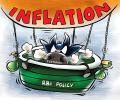
Amid a debate on the basis of a monetary policy stance, one may be curious enough to know how non-food retail inflation has behaved over the years in India. Let the eager souls catch a glimpse of facts. In the past 10 years, non-food inflation came down below 4 per cent on two occasions - pre-Covid period of 2019-20 and now in the first four months of the current financial year (FY25).

The Indian banking system's latest record on wilful defaulters shows Rs 62,970 crore, or around 10 per cent increase, in the additional amount outstanding since the pandemic began. The total outstanding amount increased to Rs 6.85 trillion in June from Rs 6.22 trillion in December 2019, shows a Business Standard analysis of numbers from the TransUnion CIBIL database. India recorded its first case of Covid-19 in January 2020.The amount outstanding to wilful defaulters had touched a post-pandemic peak of Rs.7.6 trillion in December 2020 (or Rs 1.4 trillion more than pre-pandemic levels).

While it's important to work towards saving your marriage, you must also be willing to accept that the outcome may not be what you hope for, says Dr Ashish Sehgal.

The government has budgeted for total expenditure of Rs 34.83 lakh crore or 6.8 per cent of GDP. While the net tax revenue rose from Rs 5,75,697 crore in October 2020 to Rs 10,53,135 crore till October 2021, a growth of 82.93 per cent annualized, total expenditure rose only by 9.95 per cent, led by infra spending to Rs 18,26,725 crore from Rs 16,61,454 crore during the same period, the RBI said in the financial stability report.

rediffGURU Ramalingam Kalirajan answers your personal finance queries.

Pakistan's deputy Prime Minister and Foreign Minister Ishaq Dar, who is in China on a four-day visit, and Chinese Foreign Minister Wang Yi co-chaired the fifth round of the foreign minister-level China-Pakistan Strategic Dialogue.

This year's tally is the second best ever after 2022 when 16 firms raised Rs 40,311 crore, led by LIC's biggest-ever IPO.

From the Sensex basket, Mahindra & Mahindra, Tata Motors, NTPC, HCL Technologies, Larsen & Toubro, Infosys, Tech Mahindra and State Bank of India were the major laggards. Bharti Airtel, Bajaj Finance, Bajaj Finserv, Tata Consultancy Services and IndusInd Bank were among the gainers.

Are you a first-time IPO investor? Even if IPOs appear attractive with expectations of high returns, they come with risks and complexities, cautions Sheetal Jhaveri and shares her checklist to help you navigate through the world of IPOs

Among the 30 Sensex companies, Larsen & Toubro, Power Grid, NTPC, State Bank of India, Reliance Industries and HDFC Bank were the biggest laggards. Sun Pharma and Nestle were the only gainers.
